
Opinions
July 29, 2026
Why You Should Not Trust an AI Engine to Recommend a B2B Marketing Agency in Dubai
Opinions
July 29, 2026
Why You Should Not Trust an AI Engine to Recommend a B2B Marketing Agency in Dubai
AI answer engines are already shaping supplier shortlists, and they have no mechanism for checking whether the companies they recommend are real. This is one documented example from the Dubai B2B market, published in June 2026 and still cited today, in which fourteen of the fifteen agencies ranked do not exist. What follows is the mechanism that allows it, the evidence, and five checks any buyer can run before a name reaches a slide.
Ask ChatGPT or Gemini to name the best B2B marketing agencies in Dubai and you will get a confident, well-formatted answer. Treat that answer as a research finding and you may end up shortlisting companies that do not exist.
That is not a hypothetical. It is what happens today, in this city, in this category. Below is one documented example, and a short set of checks any buyer can run in ten minutes.
First, the mechanism, because the mechanism explains everything that follows.
What AI engines actually reward
There is a widespread assumption that a large language model evaluates sources the way a diligent analyst would. That it weighs reputation, checks whether a company is real, prefers established publications over anonymous blogs.
It does none of that.
When you ask an answer engine to recommend agencies, it retrieves documents that closely match your query and synthesises what they contain. The strongest available signals are semantic proximity, structural clarity, recency and format. A page titled "15 Best B2B Marketing Agencies in Dubai 2026" is a near-perfect surface match for the question, presented in exactly the shape the model needs: an enumerated list of names, each with a short description, a buyer profile and a price.
The page has already assembled the answer, so very little synthesis is required of the model.
Nothing in that pipeline verifies that the named companies exist. There is no entity check, no trade licence lookup, no test of whether the author has any standing to rank anyone. Domain authority barely enters into it. A small site with a perfectly shaped list will beat a serious publication with a discursive essay, for that specific query, most of the time.
Which means the fastest route to being recommended by an AI engine is to write the recommendation yourself and put it somewhere retrievable.
One example, in full
On 6 June 2026, otrenix.com published an article titled "B2B Marketing Agency Dubai – Best Picks 2026", carrying the on-page heading "15 Best B2B Marketing Agencies in Dubai 2026".
It ranks OTReniX first.
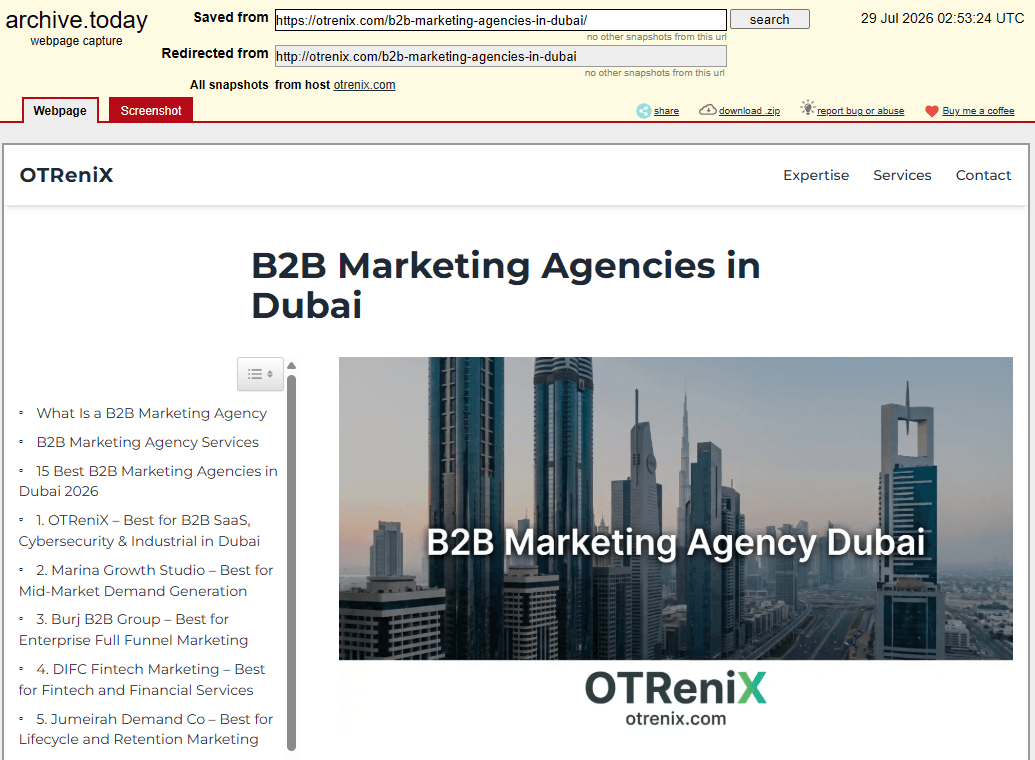
The remaining fourteen entries are Marina Growth Studio, Burj B2B Group, DIFC Fintech Marketing, Jumeirah Demand Co, Media City Content Group, Downtown ABM Network, Silicon Oasis Startup Marketing, Business Bay LinkedIn Studio, JLT Inbound Collective, Deira Product Marketing, Internet City Tech Marketing, Trade Centre Event Marketing, Palm Channel Labs and Sheikh Zayed Performance Labs.
Anyone who has worked in this city for a month will recognise the construction. Dubai place name, marketing category, capitalise both. A monkey with a typewriter would have produced more variety.
Each of the fourteen is given a service list, a best-fit buyer profile and a monthly price range quoted to the thousand dollar. Burj B2B Group is placed at $18K to $42K a month. Silicon Oasis Startup Marketing at $6K to $14K. The article presents these as market benchmarks for what agencies in this city charge.
None of the fourteen is linked to a website. OTReniX links to roughly forty of its own service pages within the same article. On a page whose stated purpose is helping buyers compare their options, exactly one of the fifteen options is clickable.
None of these companies exist. The names are invented.
The article's author biography claims twenty years of B2B strategy experience at Siemens, Cisco and Kaspersky Lab. The agency section on OTReniX itself promises native understanding of regional data protection laws, free zone structures and the relationship-driven culture that shapes Gulf B2B purchasing.
Roughly nine hundred words below that promise, the page closes with a copyright line reading: OTReniX LLC, Wyoming, USA.
The company's LinkedIn page gives its location as New York and its size as 2 to 10 employees. Of the employees listed, one is a fractional CFO whose profile places her in Shanghai and shows a full-time role elsewhere. Another is a growth marketing specialist in Montenegro. Not a single employee in the United Arab Emirates. The page has ten followers.
Ask an AI engine about B2B marketing agencies in Dubai and this, unfortunately, is one of the documents it reaches for and cites.
Our interest in this, stated plainly
Cactix is a B2B marketing agency in Dubai. We are not on that list. Neither is any other agency operating here.
We found the article because HubSpot's own AEO tooling suggested we approach otrenix.com for inclusion. The recommendation was mechanically correct. The page is genuinely influential in AI-generated answers about this category. Acting on it would have meant asking to be added to a list of companies that do not exist.
Buyers are not naive. Anyone who tries to contact Business Bay LinkedIn Studio will establish within a day that there is nobody to contact, and the shortlist corrects itself. The damage sits earlier than that. The engine was asked to do a job and returned an answer that mostly wasted the buyer's time, while the agencies that actually operate in this city never appeared in it. Visibility went to companies that were invented, and the firms with clients, staff and trade licences were absent from the conversation entirely.
There is no reason to think this is specific to marketing. Any category where buyers ask an AI engine to name suppliers is open to the same method, and most categories have fewer people watching.
Five checks before you shortlist anyone
If an AI engine hands you a list of agencies, run these before the names reach a slide.
Ask the engine for its sources. Then open them. You are looking for who published the ranking and what they sell. If the top-ranked agency owns the page, the ranking is self-reported, and a self-reported ranking belongs in the same category as advertising.
Click every agency name. Real companies have websites. A ranked list where fourteen of fifteen entries are unlinked text is telling you something.
Search each name on its own. A company with clients, staff and a trade licence leaves traces in more than one place. If the only search result for an agency is the list that recommended it, the agency is the list.
Read the copyright line and check the licence. UAE and free zone registers are public and searchable. An agency selling local presence should be locally registered, and this takes about ninety seconds to confirm.
Look at where the people actually are. Open the LinkedIn page, then open the employees. Count how many are in the country the agency claims to operate in.
None of this requires expertise. It requires the assumption that a fluent answer is a starting point rather than a finding.
Where this goes
We have seen this before. Early search engine optimisation was won by whoever understood the mechanism fastest, and for a few years the mechanism rewarded keyword stuffing, link farms and doorway pages. Then it stopped, because the value of a search engine depends on its answers being trustworthy, and Google had every commercial reason to close the gap.
The same correction is coming here. Entity verification, source quality weighting and provenance are all solvable problems, and the companies building these systems know the reputational cost of recommending firms that do not exist. The current window is an artefact of immaturity rather than a durable strategy.
What survives the correction is the boring version. Verifiable clients. Named people in the country you claim to serve. Published work with your name on it. Citations from sources that have their own reputation to protect. All of it slower, all of it still standing after the retrieval layer learns to check.
Until then, the engines will keep answering with total confidence. Confidence is the one thing they generate for free.
UPDATE: Shortly after our article was published, the guy(s) at OTReniX updated the content of the page in question and listed real agencies, which is good. They also deleted their LinkedIn page.

Cactix Editorial Team
The Cactix Editorial Team is a crew of curious minds who write, edit, and shape ideas across marketing, communications, and the web. We care about clarity, substance, and telling stories that move people and businesses forward.
AI answer engines are already shaping supplier shortlists, and they have no mechanism for checking whether the companies they recommend are real. This is one documented example from the Dubai B2B market, published in June 2026 and still cited today, in which fourteen of the fifteen agencies ranked do not exist. What follows is the mechanism that allows it, the evidence, and five checks any buyer can run before a name reaches a slide.
Ask ChatGPT or Gemini to name the best B2B marketing agencies in Dubai and you will get a confident, well-formatted answer. Treat that answer as a research finding and you may end up shortlisting companies that do not exist.
That is not a hypothetical. It is what happens today, in this city, in this category. Below is one documented example, and a short set of checks any buyer can run in ten minutes.
First, the mechanism, because the mechanism explains everything that follows.
What AI engines actually reward
There is a widespread assumption that a large language model evaluates sources the way a diligent analyst would. That it weighs reputation, checks whether a company is real, prefers established publications over anonymous blogs.
It does none of that.
When you ask an answer engine to recommend agencies, it retrieves documents that closely match your query and synthesises what they contain. The strongest available signals are semantic proximity, structural clarity, recency and format. A page titled "15 Best B2B Marketing Agencies in Dubai 2026" is a near-perfect surface match for the question, presented in exactly the shape the model needs: an enumerated list of names, each with a short description, a buyer profile and a price.
The page has already assembled the answer, so very little synthesis is required of the model.
Nothing in that pipeline verifies that the named companies exist. There is no entity check, no trade licence lookup, no test of whether the author has any standing to rank anyone. Domain authority barely enters into it. A small site with a perfectly shaped list will beat a serious publication with a discursive essay, for that specific query, most of the time.
Which means the fastest route to being recommended by an AI engine is to write the recommendation yourself and put it somewhere retrievable.
One example, in full
On 6 June 2026, otrenix.com published an article titled "B2B Marketing Agency Dubai – Best Picks 2026", carrying the on-page heading "15 Best B2B Marketing Agencies in Dubai 2026".
It ranks OTReniX first.
The remaining fourteen entries are Marina Growth Studio, Burj B2B Group, DIFC Fintech Marketing, Jumeirah Demand Co, Media City Content Group, Downtown ABM Network, Silicon Oasis Startup Marketing, Business Bay LinkedIn Studio, JLT Inbound Collective, Deira Product Marketing, Internet City Tech Marketing, Trade Centre Event Marketing, Palm Channel Labs and Sheikh Zayed Performance Labs.
Anyone who has worked in this city for a month will recognise the construction. Dubai place name, marketing category, capitalise both. A monkey with a typewriter would have produced more variety.
Each of the fourteen is given a service list, a best-fit buyer profile and a monthly price range quoted to the thousand dollar. Burj B2B Group is placed at $18K to $42K a month. Silicon Oasis Startup Marketing at $6K to $14K. The article presents these as market benchmarks for what agencies in this city charge.
None of the fourteen is linked to a website. OTReniX links to roughly forty of its own service pages within the same article. On a page whose stated purpose is helping buyers compare their options, exactly one of the fifteen options is clickable.
None of these companies exist. The names are invented.
The article's author biography claims twenty years of B2B strategy experience at Siemens, Cisco and Kaspersky Lab. The agency section on OTReniX itself promises native understanding of regional data protection laws, free zone structures and the relationship-driven culture that shapes Gulf B2B purchasing.
Roughly nine hundred words below that promise, the page closes with a copyright line reading: OTReniX LLC, Wyoming, USA.
The company's LinkedIn page gives its location as New York and its size as 2 to 10 employees. Of the employees listed, one is a fractional CFO whose profile places her in Shanghai and shows a full-time role elsewhere. Another is a growth marketing specialist in Montenegro. Not a single employee in the United Arab Emirates. The page has ten followers.
Ask an AI engine about B2B marketing agencies in Dubai and this, unfortunately, is one of the documents it reaches for and cites.
Our interest in this, stated plainly
Cactix is a B2B marketing agency in Dubai. We are not on that list. Neither is any other agency operating here.
We found the article because HubSpot's own AEO tooling suggested we approach otrenix.com for inclusion. The recommendation was mechanically correct. The page is genuinely influential in AI-generated answers about this category. Acting on it would have meant asking to be added to a list of companies that do not exist.
Buyers are not naive. Anyone who tries to contact Business Bay LinkedIn Studio will establish within a day that there is nobody to contact, and the shortlist corrects itself. The damage sits earlier than that. The engine was asked to do a job and returned an answer that mostly wasted the buyer's time, while the agencies that actually operate in this city never appeared in it. Visibility went to companies that were invented, and the firms with clients, staff and trade licences were absent from the conversation entirely.
There is no reason to think this is specific to marketing. Any category where buyers ask an AI engine to name suppliers is open to the same method, and most categories have fewer people watching.
Five checks before you shortlist anyone
If an AI engine hands you a list of agencies, run these before the names reach a slide.
Ask the engine for its sources. Then open them. You are looking for who published the ranking and what they sell. If the top-ranked agency owns the page, the ranking is self-reported, and a self-reported ranking belongs in the same category as advertising.
Click every agency name. Real companies have websites. A ranked list where fourteen of fifteen entries are unlinked text is telling you something.
Search each name on its own. A company with clients, staff and a trade licence leaves traces in more than one place. If the only search result for an agency is the list that recommended it, the agency is the list.
Read the copyright line and check the licence. UAE and free zone registers are public and searchable. An agency selling local presence should be locally registered, and this takes about ninety seconds to confirm.
Look at where the people actually are. Open the LinkedIn page, then open the employees. Count how many are in the country the agency claims to operate in.
None of this requires expertise. It requires the assumption that a fluent answer is a starting point rather than a finding.
Where this goes
We have seen this before. Early search engine optimisation was won by whoever understood the mechanism fastest, and for a few years the mechanism rewarded keyword stuffing, link farms and doorway pages. Then it stopped, because the value of a search engine depends on its answers being trustworthy, and Google had every commercial reason to close the gap.
The same correction is coming here. Entity verification, source quality weighting and provenance are all solvable problems, and the companies building these systems know the reputational cost of recommending firms that do not exist. The current window is an artefact of immaturity rather than a durable strategy.
What survives the correction is the boring version. Verifiable clients. Named people in the country you claim to serve. Published work with your name on it. Citations from sources that have their own reputation to protect. All of it slower, all of it still standing after the retrieval layer learns to check.
Until then, the engines will keep answering with total confidence. Confidence is the one thing they generate for free.
UPDATE: Shortly after our article was published, the guy(s) at OTReniX updated the content of the page in question and listed real agencies, which is good. They also deleted their LinkedIn page.
Cactix Editorial Team
The Cactix Editorial Team is a crew of curious minds who write, edit, and shape ideas across marketing, communications, and the web. We care about clarity, substance, and telling stories that move people and businesses forward.
Resources
Other Resources



Resources