
Insights
September 27, 2026
The Early Days of Industrial Marketing
Insights
September 27, 2026
The Early Days of Industrial Marketing
Almost a century back, to what it all looked like before anyone called it B2B
There is a photograph in the May 1961 issue of Industrial Marketing of a man sitting at a desk looking like he has just been caught doing something. Bug eyes, glasses, hands out of shot. Behind him, stacked like bullion, are the four volumes of the Thomas Register. The headline reads "Portrait of a buyer withdrawing his valuables." The copy explains, with some pride, that the Register weighs 48 lbs and the buyer weighs 97.
That is the whole business, in one picture. The Thomas Register was the directory of American manufacturers, four volumes of who makes what, and somewhere there is a man whose job is to choose between eleven companies that all make the same electric motor. The only way he can find out who they are is to lift 48 pounds of paper off a shelf.
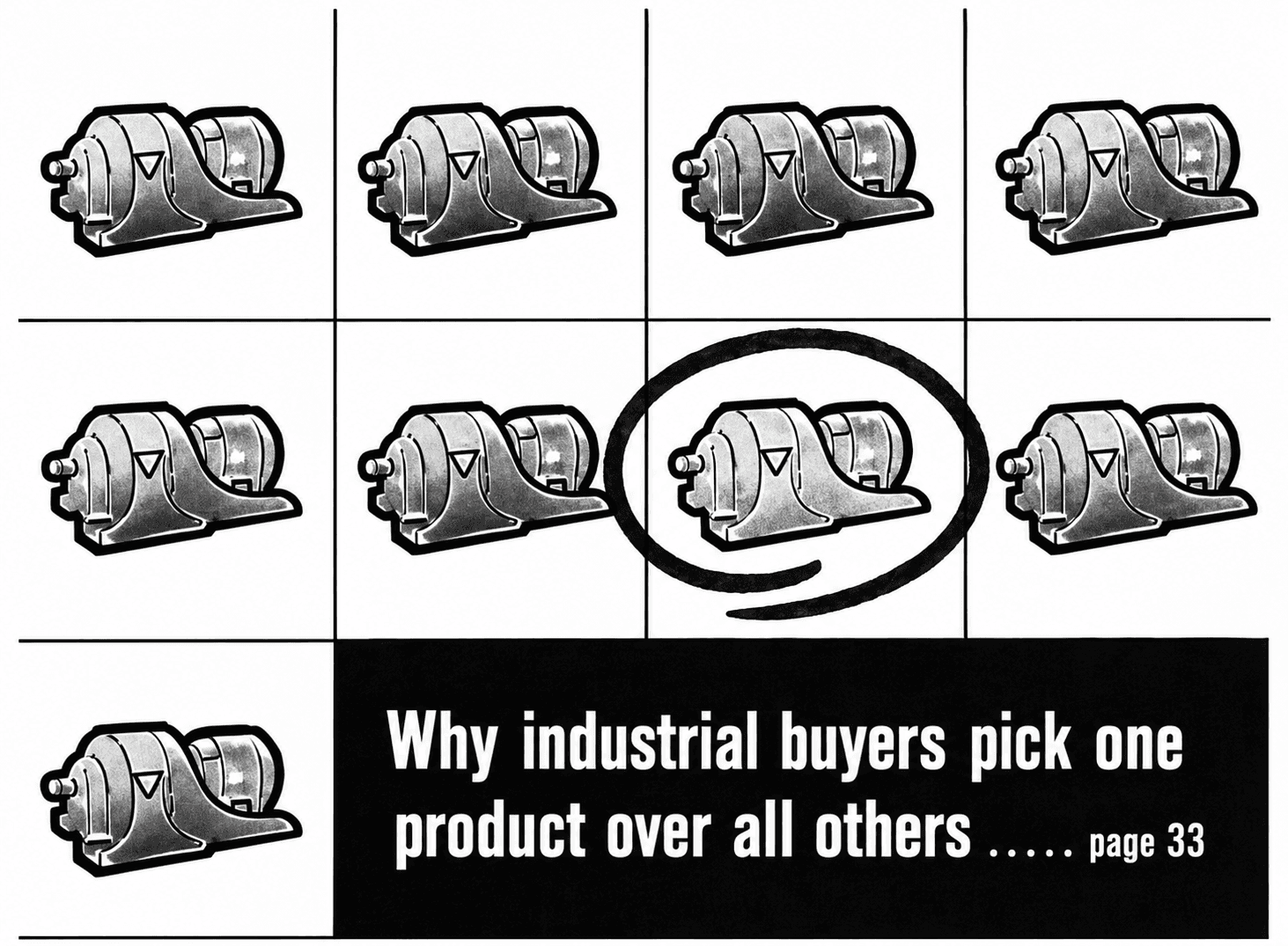
I have been looking at two issues, September 1941 and May 1961, dredged up from the corporate dark web. The 1961 one runs to 173 pages. Its cover is a grid of identical motors with one circled and the line "Why industrial buyers pick one product over all others."
Industrial marketing was the trade of selling things nobody wants for themselves. Roller bits. Tap and die sets. Concrete forms. Wheel bearing lubricant. Nobody has ever gone home and told their wife about the tap they bought. With no desire in it anywhere the whole craft had to run on something else, which is a much harder problem than selling refrigerators, and the men doing it knew that and were rather proud of it.
The May 1961 cover story is a study by a Dr Bertrand Klass, who interviewed 300 executives at 208 companies to find out who actually decides. His answer is that nobody does. There are four types and he names them like he is classifying beetles. The contributors, who are foremen and supervisors. The participants, engineers and chemists. The responsibles, the purchasing department. And the directors, who sign. Klass does not think any of this is news either. He calls his own findings "not-too-surprising".
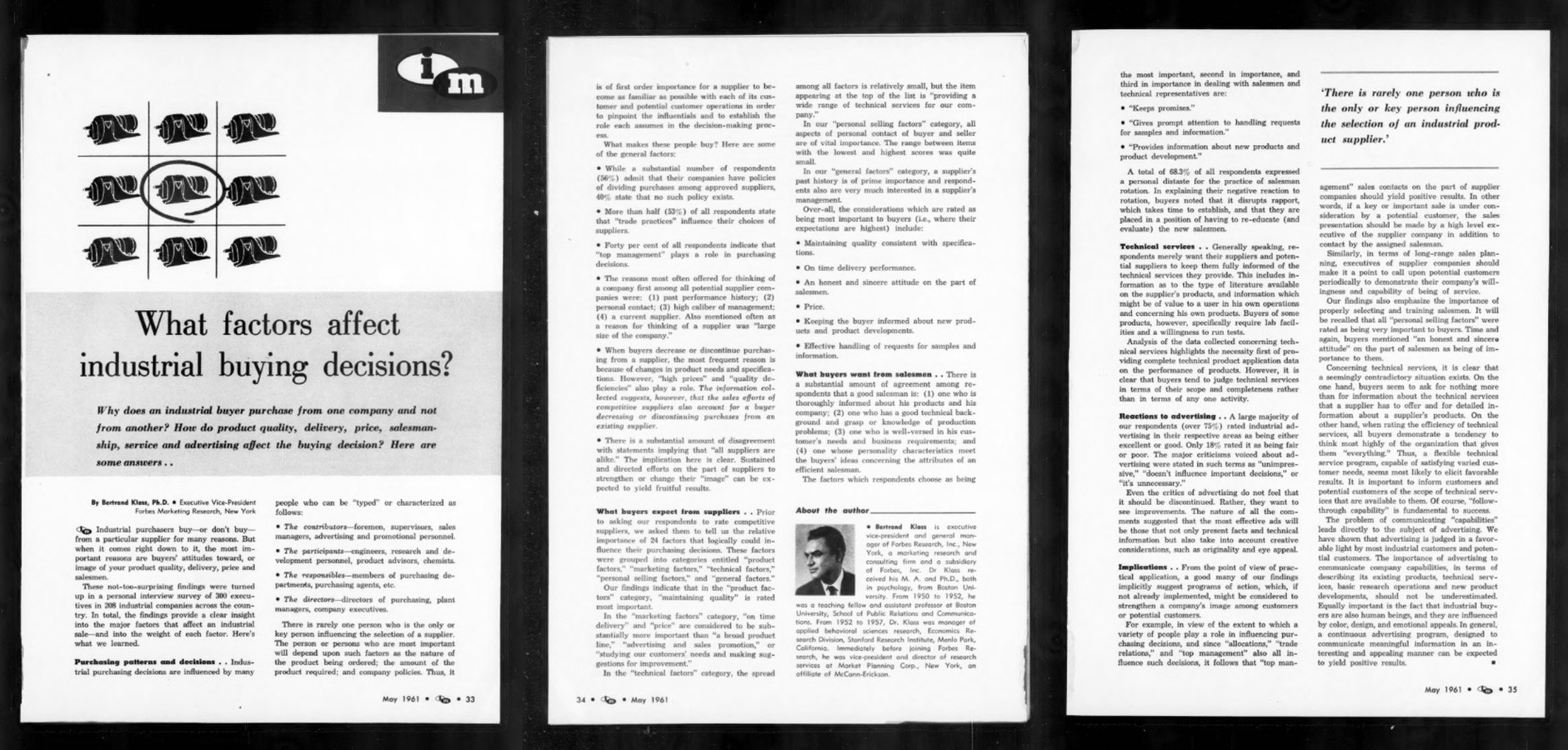
What the buyers told him they wanted, in order: quality consistent with specifications, on time delivery, an honest and sincere attitude on the part of salesmen, price.
The 1941 issue is a different world because there is a war on and nobody can sell anything. Everyone is on priorities, order books are full, and the trade press is full of people arguing about whether you should advertise at all when you have nothing to ship. My favourite piece in it is by J. Earl Brennan of Houston, headlined in swooping script, "To Sell the Man in the Oil Fields, Know His Problems." He works down the rig by job title. The driller, second in command, who cares about making hole fast and safely and not at all what it costs, because the cost is not his problem. The tool pusher. The field superintendent, whose goodwill decides everything and who will never once fill in your reply card.
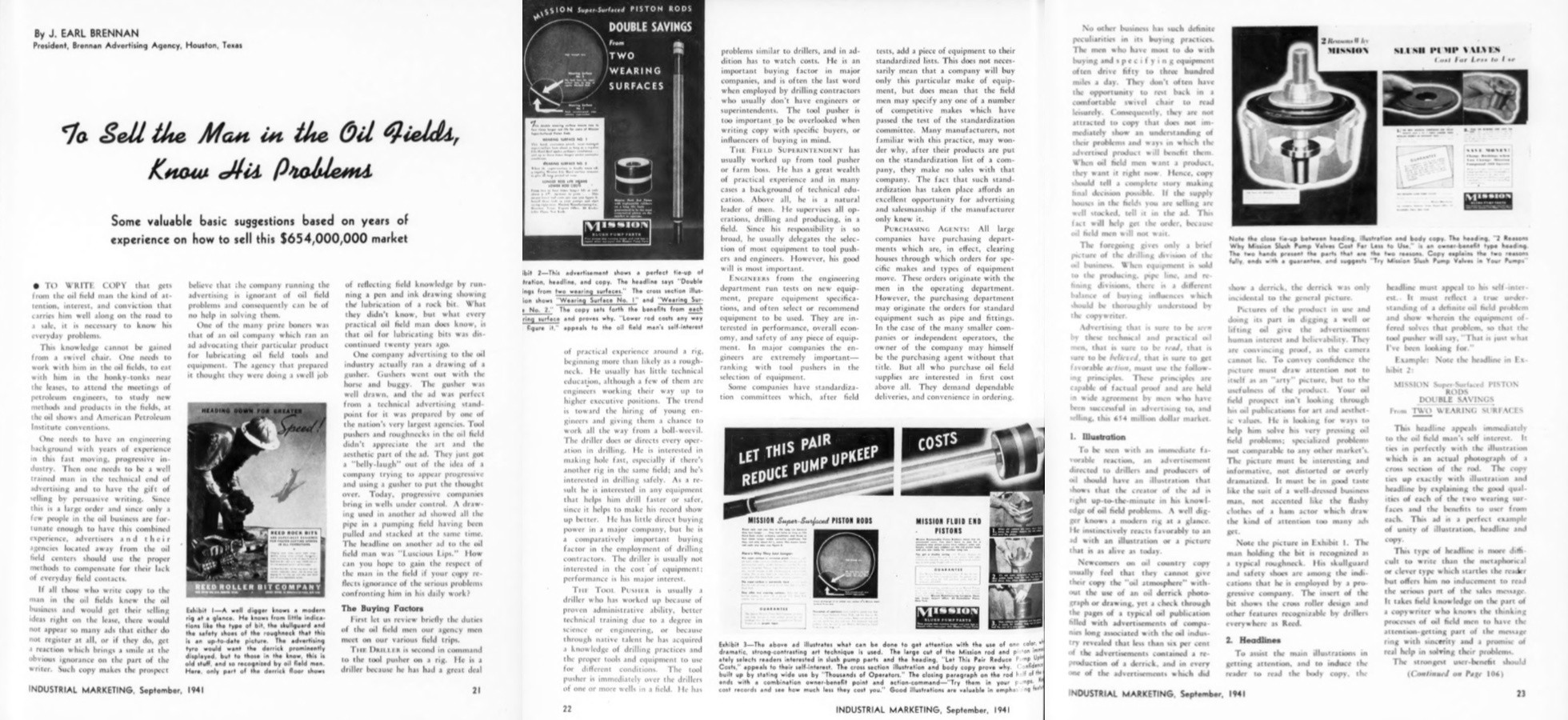
Then Brennan tells about an agency that ran an oil company ad with a drawing of a gusher in it, because a gusher looks like oil. The oil men laughed. Gushers went out with the horse and buggy, and a gusher in 1941 means somebody has lost control of the well and is about to lose the rig with it. Everybody laughed and nobody got the point, which is what happens when you write an ad from a swivel chair.
There is a column in both issues called Copy Chasers, written anonymously by working ad men who tear apart the month's advertising by name. In 1941 they go after a roller bearing manufacturer who stacked bearings of graduating diameters into the shape of a lighthouse, over the words "For National Security," then the logotype, and nothing else. They call it a real danger to the entire industrial advertising structure, which is a magnificent thing to say about a picture of a lighthouse.
In the same column they keep a running list of clichés they call Fossils. Number one, Peas in a Pod, an ad about uniformity in which the peas in the photograph are visibly not uniform. Number two, the Better Mousetrap, done the subtle way, with just the path through the woods. Number seven, Fifty Million Frenchmen, seen in the wild as "42 Million Bearings Can't Be Wrong!" Elsewhere they quote a U.S. Rubber headline, "This Seat-Covering will Save You Many a Headache," and note that the trouble with a stopper headline is that the copy never fulfils the promise.
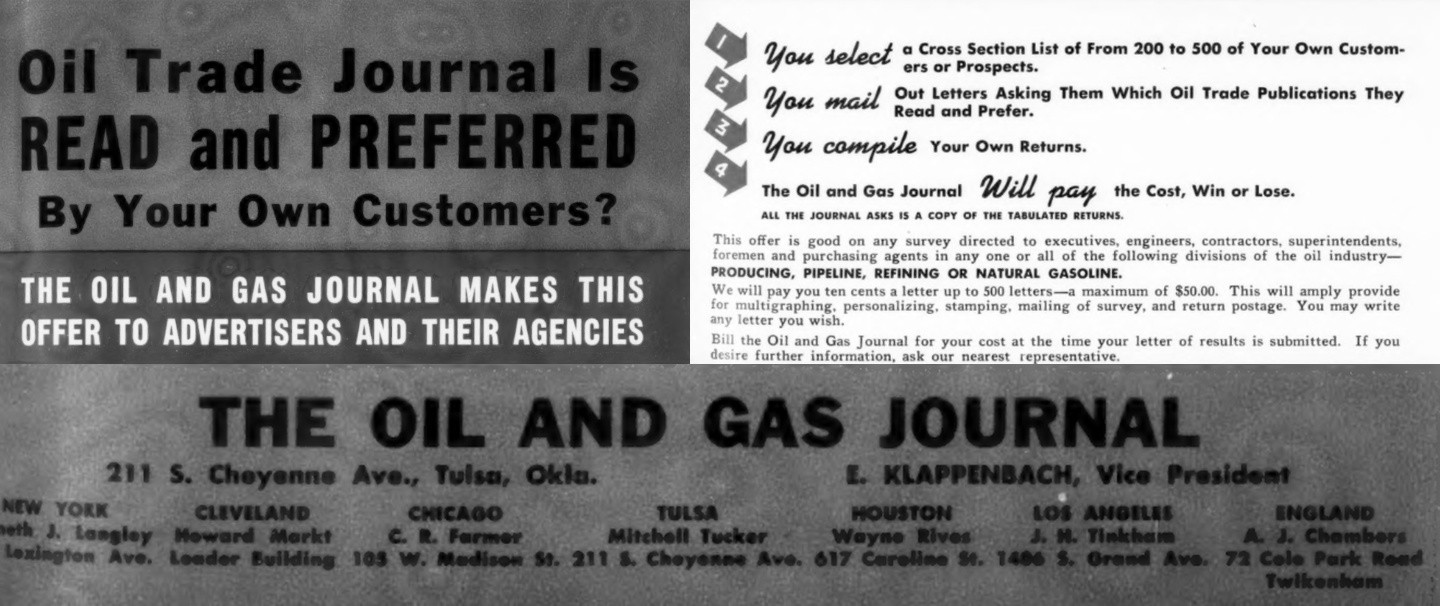
The ads for the magazines themselves are better than most of the ads in them. Proceedings of the IRE boasts 68,400 electronics engineers and adds that it is sold at the highest price any publisher has dared ask, as a selling point. The Oil and Gas Journal runs a full page offering to pay you, the advertiser, up to fifty dollars to survey your own customers about which oil trade publications they read and prefer. Ten cents a letter, up to 500 letters, postage included, win or lose. All the Journal asks is a copy of the returns. I would like to see somebody try that today.
By 1960 there were 39 companies spending over a million dollars a year in business papers alone, and the total spend in the trade press was 546.3 million dollars. One of the newcomers to the millionaires' list that year was McGraw-Hill, a publisher, buying ads in magazines. The trade had grown large enough to advertise to itself.
And the very best of it, according to the Copy Chasers, is not in any of the glossy places. It is a third-page vertical in Engineering News-Record headlined "Slab Forming," with a photograph of a slab-forming operation and one paragraph explaining that on the Stanford apartments job, Howard J. White Inc. stripped the forms in ten days without disturbing the shoring and still met the spec calling for 28 days of support.
Underneath, in display type: Material costs reduced to 10 cents a square foot. That was the best advertisement in America that month, according to the men whose job it was to know.


Mohannad
Mohannad believes great B2B marketing is built on human connection and powerful content. As founder and CEO of Cactix, he draws on a strong foundation in finance, technology, and strategy to help brands grow and succeed. He’s also a multilingual global citizen, a father of three, and an avid reader, writer, and bridge player.
Almost a century back, to what it all looked like before anyone called it B2B
There is a photograph in the May 1961 issue of Industrial Marketing of a man sitting at a desk looking like he has just been caught doing something. Bug eyes, glasses, hands out of shot. Behind him, stacked like bullion, are the four volumes of the Thomas Register. The headline reads "Portrait of a buyer withdrawing his valuables." The copy explains, with some pride, that the Register weighs 48 lbs and the buyer weighs 97.
That is the whole business, in one picture. The Thomas Register was the directory of American manufacturers, four volumes of who makes what, and somewhere there is a man whose job is to choose between eleven companies that all make the same electric motor. The only way he can find out who they are is to lift 48 pounds of paper off a shelf.
I have been looking at two issues, September 1941 and May 1961, dredged up from the corporate dark web. The 1961 one runs to 173 pages. Its cover is a grid of identical motors with one circled and the line "Why industrial buyers pick one product over all others."
Industrial marketing was the trade of selling things nobody wants for themselves. Roller bits. Tap and die sets. Concrete forms. Wheel bearing lubricant. Nobody has ever gone home and told their wife about the tap they bought. With no desire in it anywhere the whole craft had to run on something else, which is a much harder problem than selling refrigerators, and the men doing it knew that and were rather proud of it.
The May 1961 cover story is a study by a Dr Bertrand Klass, who interviewed 300 executives at 208 companies to find out who actually decides. His answer is that nobody does. There are four types and he names them like he is classifying beetles. The contributors, who are foremen and supervisors. The participants, engineers and chemists. The responsibles, the purchasing department. And the directors, who sign. Klass does not think any of this is news either. He calls his own findings "not-too-surprising".
What the buyers told him they wanted, in order: quality consistent with specifications, on time delivery, an honest and sincere attitude on the part of salesmen, price.
The 1941 issue is a different world because there is a war on and nobody can sell anything. Everyone is on priorities, order books are full, and the trade press is full of people arguing about whether you should advertise at all when you have nothing to ship. My favourite piece in it is by J. Earl Brennan of Houston, headlined in swooping script, "To Sell the Man in the Oil Fields, Know His Problems." He works down the rig by job title. The driller, second in command, who cares about making hole fast and safely and not at all what it costs, because the cost is not his problem. The tool pusher. The field superintendent, whose goodwill decides everything and who will never once fill in your reply card.
Then Brennan tells about an agency that ran an oil company ad with a drawing of a gusher in it, because a gusher looks like oil. The oil men laughed. Gushers went out with the horse and buggy, and a gusher in 1941 means somebody has lost control of the well and is about to lose the rig with it. Everybody laughed and nobody got the point, which is what happens when you write an ad from a swivel chair.
There is a column in both issues called Copy Chasers, written anonymously by working ad men who tear apart the month's advertising by name. In 1941 they go after a roller bearing manufacturer who stacked bearings of graduating diameters into the shape of a lighthouse, over the words "For National Security," then the logotype, and nothing else. They call it a real danger to the entire industrial advertising structure, which is a magnificent thing to say about a picture of a lighthouse.
In the same column they keep a running list of clichés they call Fossils. Number one, Peas in a Pod, an ad about uniformity in which the peas in the photograph are visibly not uniform. Number two, the Better Mousetrap, done the subtle way, with just the path through the woods. Number seven, Fifty Million Frenchmen, seen in the wild as "42 Million Bearings Can't Be Wrong!" Elsewhere they quote a U.S. Rubber headline, "This Seat-Covering will Save You Many a Headache," and note that the trouble with a stopper headline is that the copy never fulfils the promise.
The ads for the magazines themselves are better than most of the ads in them. Proceedings of the IRE boasts 68,400 electronics engineers and adds that it is sold at the highest price any publisher has dared ask, as a selling point. The Oil and Gas Journal runs a full page offering to pay you, the advertiser, up to fifty dollars to survey your own customers about which oil trade publications they read and prefer. Ten cents a letter, up to 500 letters, postage included, win or lose. All the Journal asks is a copy of the returns. I would like to see somebody try that today.
By 1960 there were 39 companies spending over a million dollars a year in business papers alone, and the total spend in the trade press was 546.3 million dollars. One of the newcomers to the millionaires' list that year was McGraw-Hill, a publisher, buying ads in magazines. The trade had grown large enough to advertise to itself.
And the very best of it, according to the Copy Chasers, is not in any of the glossy places. It is a third-page vertical in Engineering News-Record headlined "Slab Forming," with a photograph of a slab-forming operation and one paragraph explaining that on the Stanford apartments job, Howard J. White Inc. stripped the forms in ten days without disturbing the shoring and still met the spec calling for 28 days of support.
Underneath, in display type: Material costs reduced to 10 cents a square foot. That was the best advertisement in America that month, according to the men whose job it was to know.
Mohannad
Mohannad believes great B2B marketing is built on human connection and powerful content. As founder and CEO of Cactix, he draws on a strong foundation in finance, technology, and strategy to help brands grow and succeed. He’s also a multilingual global citizen, a father of three, and an avid reader, writer, and bridge player.
Resources
Other Resources



Resources