PPC Case Study
Optimising for real business conversions

PPC Case Study
Optimising for real business conversions
Paid search across eight countries was producing consumer enquiries. Rebuilding it around qualified leads and completed KYC tripled conversions in a quarter.
Paid search across eight countries was producing consumer enquiries. Rebuilding it around qualified leads and completed KYC tripled conversions in a quarter.
The situation
A B2B cross-border payments and FX provider was running its own paid search across eight European countries in five languages, managed by a marketing team with no paid search specialist among them. Almost all of the budget sat on branded terms. The non-branded campaigns that existed were bringing in consumer enquiries from people looking to send money to family abroad, which is a different business from the one the company is in.
Each language territory sat in its own Google Ads account, five accounts in total, with no central view across them. Campaigns typically held a single ad group, so keywords covering quite different intents competed for the same ads and the same landing page.
What made this account unusual
The conversion the client cared about was not a form submission. Their form asked prospects to open an account, which meant supplying company registration details before submitting, so the enquiry already sat well down the funnel compared with a contact request.
Beyond that, a lead only counted once it had passed qualification. Certain industries and countries were excluded on compliance grounds. The prospect had to be moving at least eighty thousand euros a year in foreign exchange volume. And the lead was only treated as converted once the KYC process completed, which happens weeks after the click that produced it.
An account measured on form submissions would have optimised toward the opposite of all this. Cheap enquiries from consumers and from below-threshold businesses are abundant in this market, and Google will find them reliably if you ask it to.
What we did
The starting point was research rather than campaign building: keyword and competitor analysis to establish what demand existed in each language, and a product session to understand which distinctions actually separated a viable prospect from a poor one.
Structure. New campaigns launched in English, where the client had none despite reasonable volume, and rebuilt campaigns across the other four languages. Each campaign received several ad groups aligned to distinct keyword themes rather than one group carrying everything. Budgets moved to portfolios so money could flow to the territories producing qualified leads rather than sitting stranded in territories that were not.
Landing pages. Each ad group got a page matching the intent behind its keywords. Before this, a large share of keywords were serving rarely or not at all because quality scores were too low to compete, and the mismatch between ad, keyword and destination was the reason.
Keywords. The research surfaced terms the client had not considered, including virtual IBAN, virtual bank account and business bank account. The last of these is worth noting because the client is not a bank, and the instinct within the business was to avoid the term. It produced a meaningful share of qualified leads.
Customers and the login page. Around a thousand clicks a month were landing on the top-navigation login link from paid traffic, which is existing customers being charged for as new demand. An exclusion audience took them out of targeting. That list needs time to reach the size at which it can serve, which is an argument for building it in the first week of an engagement rather than the third month.
Measurement. This is the part the results rest on. Rather than optimising in Google Ads against everything the conversion column counted, the campaigns were managed through HubSpot's ad management tools, so performance was read against qualified leads and completed KYC. The ad click was carried through to a contact record whose stage the sales team updated as qualification progressed, which meant the campaign, ad group, ad and keyword behind each completed KYC were knowable rather than inferred. Reporting was built in HubSpot around lead stage, lead status, lost reason, and the keyword or ad group that produced each contact.
Alongside that, a weekly report listed every lead that failed qualification, with its account, campaign, ad group, lost reason, email domain and IP country. Reviewing rejected leads in that detail every week is how the negative keyword list and the audience exclusions were actually built. Changes went out in small weekly batches so each one could be observed before the next.
What changed
Comparing the first quarter of the engagement against the client's prior full-year averages:
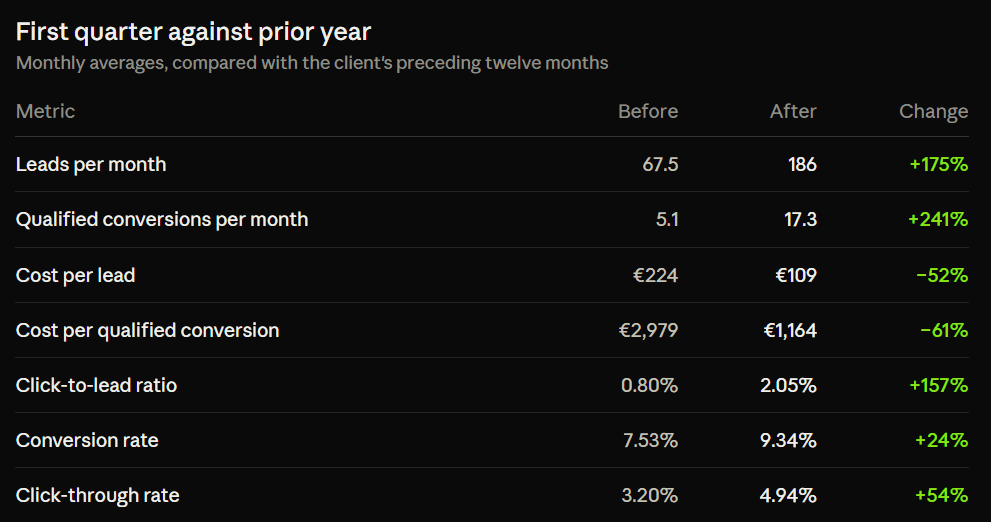
Two metrics moved the wrong way. Cost per click rose by 28%, from €1.74 to €2.23, and impressions fell by 33%. Both follow from the same decision: moving budget off branded terms, where clicks are cheap and the traffic was already coming anyway, onto competitive non-branded terms where the cost of entry is higher and impression share is harder to hold. Fewer people saw the ads. The ones who did were closer to being customers.
Spend rose 33% against the prior year average, which was authorised and consistent with the client's existing trajectory. Measured against the immediately preceding quarter rather than the year, spend was 8% lower.
The engagement continued for around three years.
What happened after
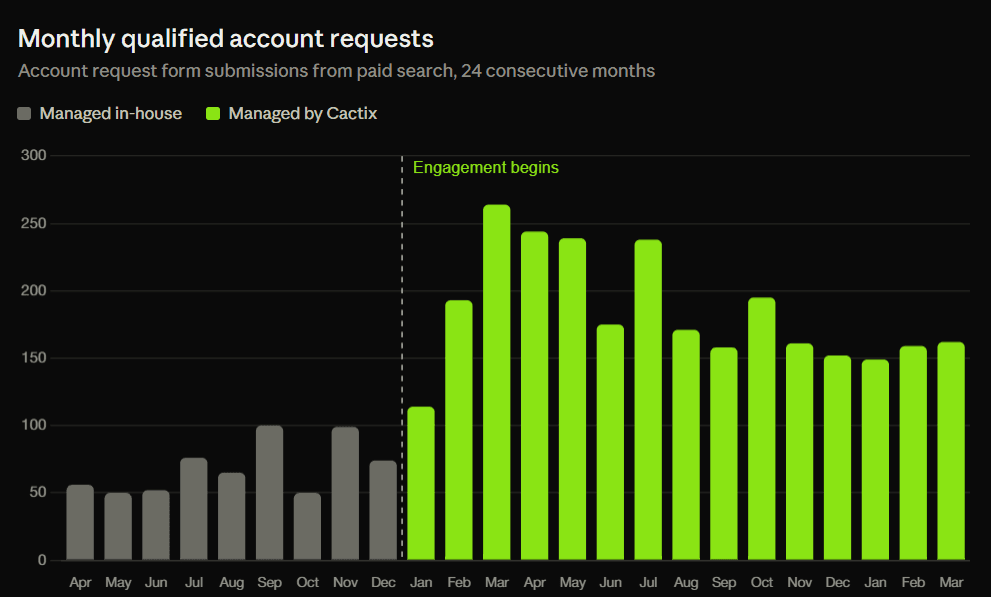
Lead volume settled below the opening surge and well above where it started. Across the following two years it ran between roughly 150 and 250 a month, against 50 to 100 before the work began. Some of that variation followed budget, which the client moved up and down by territory over the period, and cost per lead rose as auction prices climbed.
Optimising against completed KYC rather than form submissions is the decision the rest of it rests on. It is the reason the qualified conversion figure moved further than the lead figure did, and it remains the first thing we look at on any account we take over.
Paid search across eight countries was producing consumer enquiries. Rebuilding it around qualified leads and completed KYC tripled conversions in a quarter.
The situation
A B2B cross-border payments and FX provider was running its own paid search across eight European countries in five languages, managed by a marketing team with no paid search specialist among them. Almost all of the budget sat on branded terms. The non-branded campaigns that existed were bringing in consumer enquiries from people looking to send money to family abroad, which is a different business from the one the company is in.
Each language territory sat in its own Google Ads account, five accounts in total, with no central view across them. Campaigns typically held a single ad group, so keywords covering quite different intents competed for the same ads and the same landing page.
What made this account unusual
The conversion the client cared about was not a form submission. Their form asked prospects to open an account, which meant supplying company registration details before submitting, so the enquiry already sat well down the funnel compared with a contact request.
Beyond that, a lead only counted once it had passed qualification. Certain industries and countries were excluded on compliance grounds. The prospect had to be moving at least eighty thousand euros a year in foreign exchange volume. And the lead was only treated as converted once the KYC process completed, which happens weeks after the click that produced it.
An account measured on form submissions would have optimised toward the opposite of all this. Cheap enquiries from consumers and from below-threshold businesses are abundant in this market, and Google will find them reliably if you ask it to.
What we did
The starting point was research rather than campaign building: keyword and competitor analysis to establish what demand existed in each language, and a product session to understand which distinctions actually separated a viable prospect from a poor one.
Structure. New campaigns launched in English, where the client had none despite reasonable volume, and rebuilt campaigns across the other four languages. Each campaign received several ad groups aligned to distinct keyword themes rather than one group carrying everything. Budgets moved to portfolios so money could flow to the territories producing qualified leads rather than sitting stranded in territories that were not.
Landing pages. Each ad group got a page matching the intent behind its keywords. Before this, a large share of keywords were serving rarely or not at all because quality scores were too low to compete, and the mismatch between ad, keyword and destination was the reason.
Keywords. The research surfaced terms the client had not considered, including virtual IBAN, virtual bank account and business bank account. The last of these is worth noting because the client is not a bank, and the instinct within the business was to avoid the term. It produced a meaningful share of qualified leads.
Customers and the login page. Around a thousand clicks a month were landing on the top-navigation login link from paid traffic, which is existing customers being charged for as new demand. An exclusion audience took them out of targeting. That list needs time to reach the size at which it can serve, which is an argument for building it in the first week of an engagement rather than the third month.
Measurement. This is the part the results rest on. Rather than optimising in Google Ads against everything the conversion column counted, the campaigns were managed through HubSpot's ad management tools, so performance was read against qualified leads and completed KYC. The ad click was carried through to a contact record whose stage the sales team updated as qualification progressed, which meant the campaign, ad group, ad and keyword behind each completed KYC were knowable rather than inferred. Reporting was built in HubSpot around lead stage, lead status, lost reason, and the keyword or ad group that produced each contact.
Alongside that, a weekly report listed every lead that failed qualification, with its account, campaign, ad group, lost reason, email domain and IP country. Reviewing rejected leads in that detail every week is how the negative keyword list and the audience exclusions were actually built. Changes went out in small weekly batches so each one could be observed before the next.
What changed
Comparing the first quarter of the engagement against the client's prior full-year averages:
Two metrics moved the wrong way. Cost per click rose by 28%, from €1.74 to €2.23, and impressions fell by 33%. Both follow from the same decision: moving budget off branded terms, where clicks are cheap and the traffic was already coming anyway, onto competitive non-branded terms where the cost of entry is higher and impression share is harder to hold. Fewer people saw the ads. The ones who did were closer to being customers.
Spend rose 33% against the prior year average, which was authorised and consistent with the client's existing trajectory. Measured against the immediately preceding quarter rather than the year, spend was 8% lower.
The engagement continued for around three years.
What happened after
Lead volume settled below the opening surge and well above where it started. Across the following two years it ran between roughly 150 and 250 a month, against 50 to 100 before the work began. Some of that variation followed budget, which the client moved up and down by territory over the period, and cost per lead rose as auction prices climbed.
Optimising against completed KYC rather than form submissions is the decision the rest of it rests on. It is the reason the qualified conversion figure moved further than the lead figure did, and it remains the first thing we look at on any account we take over.